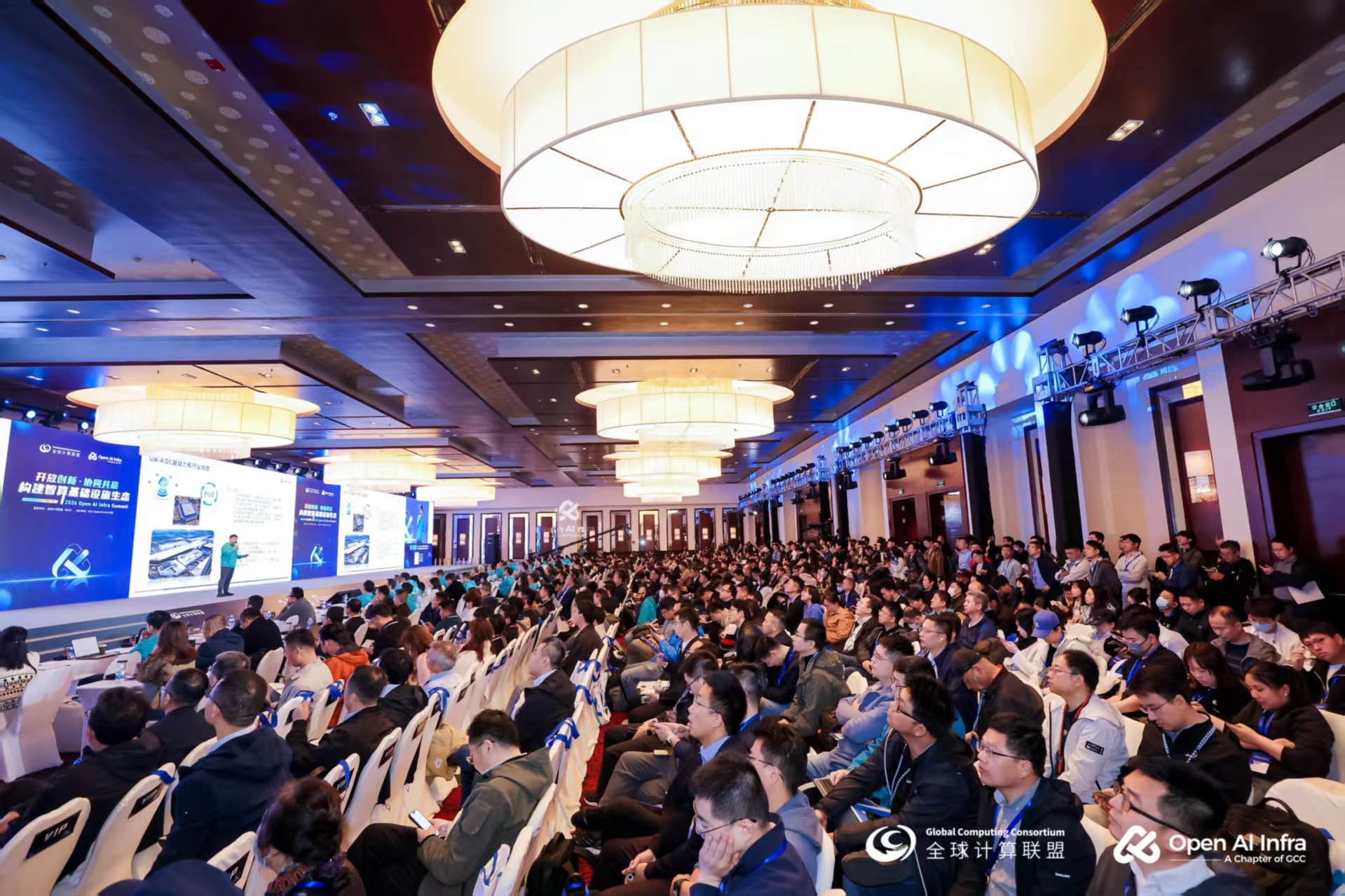
The 2026 Open AI Infra Summit, guided by the Global Computing Consortium (GCC) and hosted by the GCC-Open AI Infra Community, was successfully held in Beijing. This annual event is a major industry gathering for the AI computing infrastructure field, both domestically and internationally. The community has brought together more than 150 core organizations across the industrial chain, covering internet companies, telecom operators, chip manufacturers, system integrators, liquid cooling, power supply and distribution, data centers, and other full-chain partners. Leaders and technical experts from numerous community member organizations—including internet firms, telecom operators, and core technology providers—along with over 1,500 ecosystem partners and industry peers in the AI Infra field, gathered to co-create an industry event focused on AI computing power infrastructure.
Strategic Guidance: Co-building the Ecosystem Blueprint
Professor Zheng Weimin, Chair of the Open AI Infra Community Advisory Committee, member of the GCC Strategic Advisory Committee, academician of the Chinese Academy of Engineering, and professor at Tsinghua University, together with Professor Jin Hai, Chairman of the Global Computing Consortium, professor and doctoral supervisor at Huazhong University of Science and Technology, delivered opening remarks. Chairman Jin Hai emphasized that the community must adhere to the principles of fairness, impartiality, and openness, focus on tackling core technologies such as megawatt�scale computing systems and super-node clusters, and promote the implementation of standards and results. Professor Zheng Weimin noted that future computing power will take the form of a new type of intelligent complex that deeply integrates computation, storage, transmission, control, and cooling. He added that the community will continue to make strides in areas such as optical interconnection, megawatt�scale computing systems, system R&D, and benchmarking systems, working together to build an open, collaborative, secure, and reliable global computing ecosystem.
Holistic Development: Joining Forces for Ecosystem Co-construction
Zhang Chun, Chair of the Open AI Infra Community Management Committee and representative of China Mobile, shared in his presentation that the community has always adhered to the core philosophy of "open collaboration, technology leadership, and closed-loop industrial implementation", striving to build AI-ready computing infrastructure adapted to the AI era. Going forward, the community will continue to embrace the concept of "open innovation, collaborative win-win" and work with all member organizations to forge a more prosperous, efficient, and sustainable new ecosystem for AI computing power.
During the summit, a certificate presentation ceremony for Advisory Committee members and an appointment ceremony for project group leaders were held. At the same time, nine corporate experts, including Cao Weibing from 21Vianet Group and Mo Pobo from Huawei, received the "2025 Expert Contribution Award". Four companies, including ByteDance and Huawei, were honored with the "2025 Member Contribution Award". Three individuals, including Wang Shifeng from ByteDance, received the "2025 Outstanding Service Award".
During the achievements release session, Yu Xiongjie, Co�Chair of the Community Technical Steering Committee and a technical expert from ByteDance, stated that the community adheres to a pragmatic approach, emphasizing standards, certification, and real�world implementation. The community has jointly released several significant achievements together with numerous enterprises and experts, fully demonstrating the effectiveness of its phased work.
Following that, the summit officially released three technical specifications: "GCC Liquid-Cooled Rack-Scale System Architecture Design Specification – Type A", "GCC Liquid-Cooled Rack Interface Specification", and "AIDC Infrastructure Specification". Also unveiled were the "Super-Node Performance Benchmark Tools" – the AI computing super-node benchmark AISBench V3.0 and the general-purpose computing super-node benchmark ClusterBench V1.0. In addition, the "Open AI Infra Community AIDC Demonstration Site Illumination Program & AIDC Demonstration Site Certification Project" was officially announced, demonstrating benchmark leadership and standard certification for large-scale deployment of AI infrastructure. Furthermore, the community launched the "Megawatt�Scale Computing System" project. This project was jointly proposed by users such as China Mobile, ByteDance, Baidu, JD.com, and Kuaishou; computing system partners including Huawei, H3C, Super Fusion, and Ruijie; and community industry partners in liquid cooling, power supply, and interconnection. It aims to unite the full strength of the community's industrial chain to tackle core technical bottlenecks in megawatt-scale computing systems.
Technical Insights: Cutting-edge Practices and Perspectives
During the summit, multiple industry experts delivered speeches, drawing on the community's technical foundation and practical experience to share their latest exploration results, providing professional guidance and food for thought for the industry's development. Gao Xiaojun from ByteDance pointed out that next-generation AI super-nodes urgently need to achieve elastic scaling and rapid deployment through open architectures and diverse computing power layouts. Jing Tangbo from ByteDance summarized three major technology trends for gigawatt�scale data centers and the challenges faced in large-scale construction. Long Pan from Huawei noted that the fundamental unit of future AIDC is the megawatt�scale computing system, with efficient power supply, closed�loop liquid cooling, and high-density optical interconnection forming the core foundation. Zhang Guangbin, Secretary-General of the Open AI Infra Community, mentioned that the technology stack from megawatt�scale computing systems to gigawatt-scale data centers can be summarized under five scales – K/M/G/T/P – and that the Open AI Infra Community is steadily carrying out related work, welcoming active participation from members. Wang Guilin from JD Cloud stated that JD Cloud will contribute to the community its technical design and practical deployment experience for JD Tian Shu rack-scale systems, helping to standardize liquid cooling. Yan Kun from 21Vianet Group proposed fully embracing the community's infrastructure specifications to create the first demonstration site based on the "AIDC Infrastructure Specification". Liu Peiguo from Huawei emphasized the need to build AI infrastructure that is chip-friendly, grid-friendly, environment-friendly, and customer-friendly. Li Yunbiao from Super Fusion introduced that his company is taking the lead in advancing the development of the OAII Community's GCC Liquid�Cooled Rack�Scale System Architecture Design Specification – Type B. Li Xinqi from Envicool pointed out that two-phase liquid cooling technology has disruptive innovation potential, and extreme collaborative design of rack-scale systems is the future direction. Wang Feng from H3C noted that the era of intelligent agents has arrived, and the industry urgently needs to build diversified, open, and efficient standardized AI Infra innovation architectures.
Conclusion
The 2026 Open AI Infra Summit, grounded in openness and elevated by collaboration, brought together the wisdom and strength of the entire industrial chain to explore technology pathways, build standard systems, and foster ecosystem prosperity. Going forward, the Open AI Infra Community will continue to join hands with all member organizations to deeply cultivate the field of AI computing infrastructure and co-create an efficient, inclusive, green, and sustainable new intelligent computing ecosystem.

 High Performance Computing Development Group(HPC DG)