As AI large models place higher demands on computing power, memory bandwidth, and energy efficiency, low-bit-width data formats are becoming a key technological direction for improving the efficiency of large model training and inference, thanks to their significant advantages in computational efficiency, storage overhead, and energy consumption control. From May 5 to 6, Paris time, Huawei Technologies Co., Ltd., a Platinum member of the Global Computing Consortium (GCC), showcased its self-developed HiFloat series of low-bit-width data formats at GOSIM Paris 2026, a global open-source innovation event. Huawei shared practical results of this technology in large model training and inference. Currently, the GCC-HiFloat community has launched its first season of the "HiFloat Large Model Co-Creation Initiative" focused on model validation, driving low-bit-width computing from technological exploration toward large-scale application.
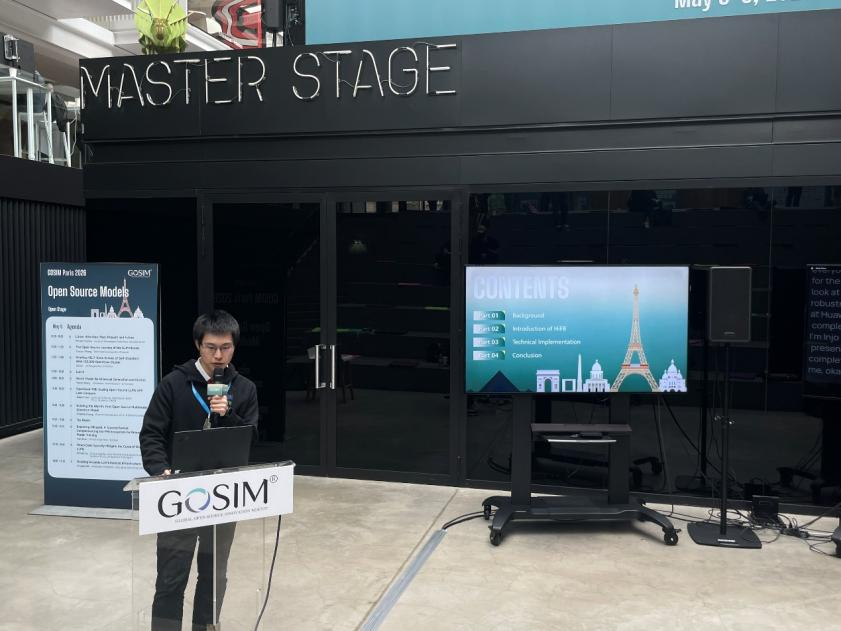
GOSIM Paris 2026: An International Open-Source Technology Exchange
GOSIM Paris 2026 is an international open-source technology exchange event for global open-source developers, researchers, technology companies, and industrial ecosystem partners. The conference focuses on cutting-edge directions such as open-source AI, intelligent agents, edge intelligence, AI hardware, and open-source models, bringing together global technology companies including Google, Intel, NVIDIA, Arm, Huawei, and ByteDance, as well as open-source projects and research institutions. The debut of the HiFloat series of low-bit-width data formats on this international open-source stage highlights the significant value of low-bit-width computing in high-efficiency large model training and inference scenarios, while also providing a new window for global developers and industry partners to participate in the ecological development of low-bit-width data formats.
Low-Bit-Width Data Formats for High-Efficiency Large Model Computing
With the continued growth in large model parameter scales, training data, and inference demand, AI computing is facing increasing pressure in terms of computing power, memory, energy consumption, and cost. Reducing computational resource consumption while preserving model performance and training stability to the greatest extent possible has become a major technological direction in the AI infrastructure field.
HiFloat is a low-bit-width floating-point data format designed for high-efficiency large model computing in the era of intelligent computing, focusing primarily on 8-bit and sub-8-bit low-bit-width computing scenarios. In simple terms, HiFloat aims to accomplish more efficient AI computing with fewer data bits, reducing memory usage, computational overhead, and energy costs during training and inference while maintaining model accuracy and stability.
HiFloat8: Simplifying Large Model Training, Enhancing Efficiency and Stability
In response to the growing demand for computing power and memory from large models, HiFloat8, as an innovative 8-bit floating-point format, seeks to address pain points such as instability and complex processes in existing low-bit-width training solutions. Through innovative design, HiFloat8 achieves unified training and inference, attaining training stability close to that of high-precision formats without requiring complex scaling strategies, while significantly improving training efficiency.
From Technical Seminars to International Challenges: Continuously Advancing Model Validation and Engineering Practice
The HiFloat series has already been validated across a wide range of scenarios, from classic models to hundred-billion-parameter large models, demonstrating strong potential in accuracy retention, energy efficiency improvement, and cost optimization in relevant validation scenarios. Furthermore, Huawei's next-generation Ascend AI chips will natively support the HiFloat series formats, providing further support for the large-scale application of low-bit-width data formats in AI training, inference, and engineering deployment.

In the IEEE ICME 2026 Grand Challenge, which is nearing its conclusion, GCC served as the organizer of a technical challenge focused on low-bit-width quantization. The challenge has already yielded validation results from more than 15 companies, universities, and research institutions both domestically and internationally. These results will be further presented and discussed at a dedicated workshop to be held in Bangkok, Thailand, this July.
Going forward, GCC will leverage the HiFloat community as an open collaboration gateway, continuing to promote collaborative innovation in low-bit-width data formats across standard openness, model validation, engineering practice, and industrial application. The GCC-HiFloat community has already launched the first phase of the "HiFloat Large Model Co-Creation Initiative" focused on model validation, extending a broad invitation to industry developers, model teams, AI framework and toolchain partners, and research institutions to participate in validation and co-creation activities centered on real-world models and engineering scenarios, driving low-bit-width computing from technological exploration toward large-scale application.

Scan the QR code to view event details
https://www.gccorg.com/article/50/18.html
If you wish to learn more about work related to HiFloat low-bit-width computing, or to participate in subsequent GCC-HiFloat community technical seminars, joint standards development, industry co-innovation, and ecosystem collaboration activities, please contact:
GCC-HiFloat Community. gcc_hifloat@gccorg.com

 High Performance Computing Development Group(HPC DG)