On August 2, 2025, the 2025 Confidential Computing Second Plane Forum was successfully held in Beijing. The forum was hosted by the China Computer Federation and jointly organized by the Confidential Computing Committee of the Global Computing Consortium (GCC), the CCF Technical Committee on Fault-Tolerant Computing, the CCF Technical Committee on Computer Architecture, Huawei Institute of Strategic Research, Huawei Trusted Computing Scientist Committee, the University of Science and Technology of China, and other institutions.

The forum brought together leading industry experts, scholars, and corporate representatives to discuss frontier topics in confidential computing, including industrial development, academic research, and the Trusted Computing Special Program under the Populus Grove Fund. It provided an important platform for exchange and collaboration to advance the development and application of confidential computing technologies.
The forum began at 9:00 a.m. with an opening speech by Feng Dengguo, Chair of the Expert Committee of the GCC Confidential Computing Committee and Academician of the Chinese Academy of Sciences. He emphasized the importance of confidential computing in protecting data security and achieving independent and controllable technologies.

He also discussed the challenges facing the industrialization of confidential computing, including side-channel attacks, performance overhead, the placement of trust anchors, and ecosystem development. He encouraged young researchers to innovate boldly, overcome challenges, and jointly promote the development of confidential computing technologies and the broader industry. He also noted that the GCC Confidential Computing Committee and the CCF Populus Grove Fund have built a valuable platform for exchange between industry and academia, and expressed his hope for more communication, collaboration, and ecosystem prosperity.
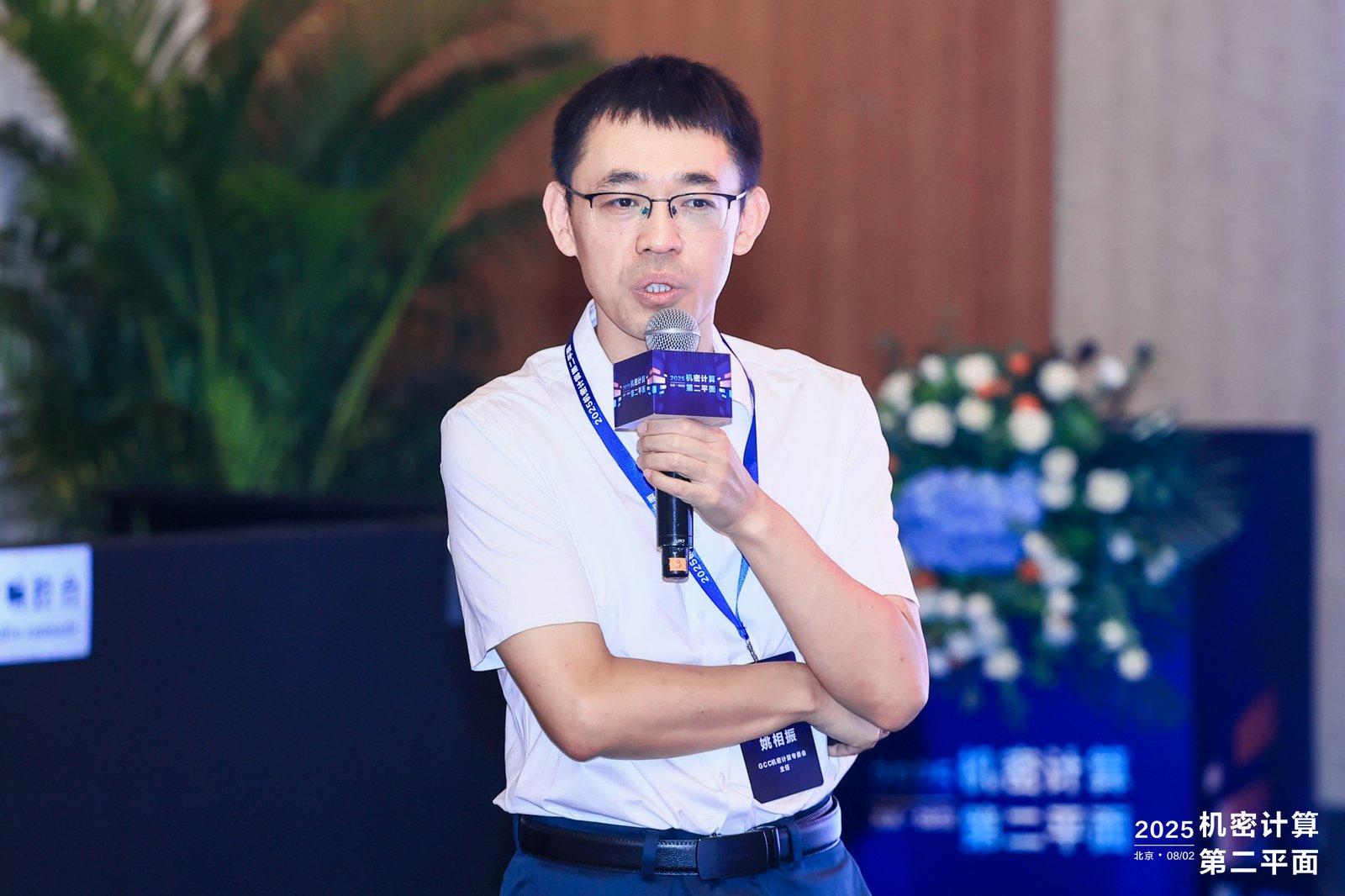
Yao Xiangzhen, Chair of the GCC Confidential Computing Committee, introduced the committee’s latest work progress. He presented the committee’s organizational structure and operating model, reviewed its progress over the past year in confidential computing standards development and standard adoption, and shared its achievements in promoting ecosystem development and international cooperation in confidential computing.
IEEE Fellow Gang Qu delivered a presentation titled On Confidential Computing: Lessons Learned from Hardware Security Research. From the perspective of hardware security, he shared his views on what confidential computing is, where it comes from, and how it may develop in the future.
Industry Frontiers: Advancing Confidential Computing Applications
In the industry frontier session, multiple experts shared the latest progress in applying confidential computing across industrial scenarios.
Wu Ye, Head of the Security Research Team at Douyin Group, introduced Jeddak AICC confidential computing and security applications, demonstrating innovative applications of confidential computing in real business scenarios.
Jin Yi’er, Chief Scientist of Trusted Computing at Huawei, explained the progress of confidential computing evaluation standards, providing a standardization reference for the industry.
Zhang Yufei, Solution Expert at Hygon, introduced Hygon’s CSV architecture for confidential computing, showcasing technological breakthroughs by domestic chips in this field.
Liu Shuang from Ant Group’s secure computing team shared HyperGPU: A Privacy-Preserving Solution for Large Models Based on General-Purpose Hardware, offering a new approach to integrating artificial intelligence with confidential computing.
Zhao Shuai, Technical Lead of the Linaro Datacenter Group, introduced the latest open-source
progress of Arm Confidential Compute Architecture (CCA), helping advance the open-source ecosystem for confidential computing.
Qin Yu, Researcher at the Institute of Software, Chinese Academy of Sciences, shared technologies related to elastic collaborative roots of trust for confidential computing, providing technical support for building more secure and reliable computing environments.
Li Yongsong, Chief Engineer at the Solution Center of NSFOCUS, introduced innovation and practice in trusted data spaces based on provable security, demonstrating innovative applications of confidential computing in data security.
Academic Frontiers: Exploring the Unknown and Leading the Future
In the afternoon academic frontier session, Zhang Lei from Nanhu Laboratory introduced confidential computing frameworks and applications, including applications in intellectual property protection and AI model security.
Han Weili from Fudan University shared Garnet: Data Sharing and Utilization Based on Secure Multi-Party Computation.
Zhang Fengwei from the Southern University of Science and Technology discussed research on heterogeneous confidential computing security systems.
Bian Song from Beihang University introduced frontier technologies and research progress in confidential blockchain.
These academic presentations showcased the latest achievements in theoretical research and technological innovation in confidential computing, offering guidance for future academic research and industrial applications.
Populus Grove Fund Trusted Computing Special Program: Supporting Talent Development and Technological Innovation
In the session dedicated to the Trusted Computing Special Program under the Populus Grove Fund, Shen Haihua, Deputy Chair of the CCF Technical Committee on Fault-Tolerant Computing, and Li Chao, Deputy Chair of the CCF Technical Committee on Computer Architecture, each delivered remarks. They emphasized the important role of the Populus Grove Fund in supporting talent development and technological innovation in trusted computing.
Professor Shen Haihua noted that the populus tree is known for “living for a thousand years without dying, standing for a thousand years after death, and remaining enduring for a thousand years after falling.” The spirit of the populus grove symbolizes resilience, hope, and dedication. He expressed his hope that young scholars would be inspired by this spirit and achieve more results with the support of the Populus Grove Fund.
The Populus Grove Fund was established by Huawei for the broader computing field. Through cooperation with the China Computer Federation, it builds a platform for industry-academia collaboration, connects industrial practices with academic research questions, and supports outstanding young scholars in China and abroad in conducting frontier research linked to industrial needs.
The Trusted Computing Special Program under the Populus Grove Fund supports the development of trusted computing, trusted execution environments, cybersecurity, and related fields in China. It aims to advance trusted computing technologies and competitiveness, cultivate talent in trusted computing and cybersecurity, promote the prosperity of trusted computing and cybersecurity technologies and ecosystems, and accelerate university-enterprise collaboration and technology transfer.
Jin Yi’er, Chief Scientist of Trusted Computing at Huawei, reviewed the Trusted Computing Special Program under the Populus Grove Fund over the past years and introduced the 2025 project plan. Finally, recipients of the 2024 Populus Grove Fund presented posters showcasing their research achievements in trusted computing.
Closing: Looking Ahead and Moving Forward
Through in-depth exchanges and discussions across multiple sessions, the forum provided experts, scholars, and corporate representatives in the field of confidential computing with a broad platform for communication, collaboration, and mutual benefit.
The successful convening of the forum will further promote the development and application of confidential computing technologies and contribute to building a more secure and reliable digital world.
Looking ahead, with the joint efforts of all parties, the field of confidential computing is expected to embrace even broader development prospects.

 High Performance Computing Development Group(HPC DG)