[Shanghai, China – July 19, 2026] During the World Artificial Intelligence Conference (WAIC) 2026, Gao Wen, Director of Peng Cheng Laboratory (PCL), and Jin Hai, Chairman of the Global Computing Consortium (GCC), jointly released the SuperPod Definition and Practice White Paper. Co-led by GCC and PCL with participation from the full industry chain, this white paper provides the first comprehensive clarification of the core definition, architectural characteristics, and core technology framework of SuperPods. It identifies three major technical features, outlines ten core value scenarios, and compiles benchmark implementation cases across the entire industry chain—establishing technical standards, defining evolutionary directions, and providing practical benchmarks for the next generation of intelligent computing infrastructure worldwide.

Official release of the SuperPod Definition and Practice White Paper
Concurrently with the white paper release, Gao Wen, Chairman of the GCC Strategic Advisory Committee (SAC) and Director of Peng Cheng Laboratory, delivered a keynote speech highlighting the newly released SuperPod Definition and Practice White Paper, systematically explaining the standardized definition and characteristics of SuperPods, and clearly stating: SuperPods have become a new paradigm for AI infrastructure construction.
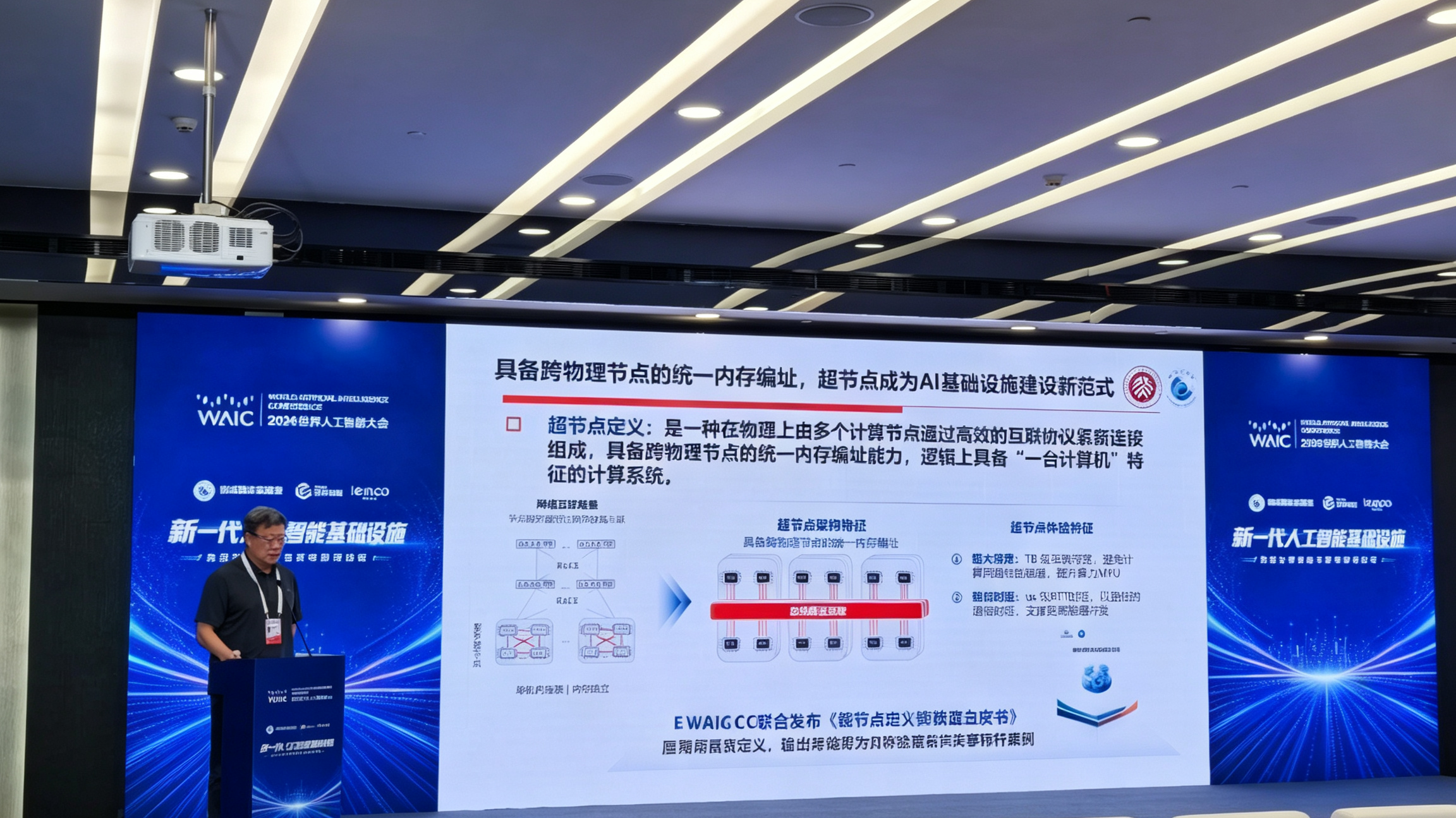
Gao Wen, Chairman of the GCC Strategic Advisory Committee (SAC) and Director of Peng Cheng Laboratory, presenting the SuperPod Definition and Practice White Paper
Addressing Core Industry Pain Points: Filling the Global SuperPod Standards Gap
Today, as large models with hundreds of billions and trillions of parameters continue to iterate and upgrade, AI computing power demand is experiencing exponential growth. Traditional server stacking architectures, constrained by latency and bandwidth bottlenecks, can no longer support large-scale training and inference workloads for ultra-large models. For a long time, the global computing industry has lacked a unified SuperPod definition, standardized architectural specifications, and reusable implementation solutions. Technology roadmaps remain fragmented across enterprises and research institutions, with high collaboration barriers and deployment costs across the industry chain—severely constraining the large-scale evolution of intelligent computing infrastructure.
In response to these shared pain points across the global computing industry, GCC and PCL have united the collaborative efforts of industry, academia, research, and application across the full industry chain to systematically organize and standardize the SuperPod framework, establishing a complete technical and practical system.
The white paper defines: A SuperPod is a computing system physically composed of multiple compute nodes tightly connected through high-efficiency interconnect protocols, with the capability of unified memory addressing across physical nodes, and logically exhibiting the characteristics of "a single computer." Among these, unified memory
addressing across physical nodes is the core architectural feature of SuperPods. "Memory Semantics," "Unified Memory Addressing," ultra-low latency, and ultra-large bandwidth together constitute the three major technical features of SuperPods.

Full-Scenario Implementation Verification: Breakthrough Performance Gains Across Five Core Scenarios
The newly released white paper includes extensive cases of industrial-scale deployment and commercial implementation, with massive real-world test data fully demonstrating that SuperPods have moved beyond the theoretical concept stage to become a new type of intelligent computing infrastructure that is technologically mature, deployable, and scalable for widespread adoption—achieving comprehensive performance breakthroughs across the full chain of AI training and inference scenarios, with distinct core advantages:
1. Large Model Training Scenario: Breaking Through Long-Sequence Training Bottlenecks
With unified memory addressing in SuperPods, the global batch size during long-sequence training (e.g., 128K/256K) can be significantly increased without frequent cross-node checkpoint saving and parameter redistribution, effectively simplifying the training process, reducing resource consumption, and improving the stability and efficiency of long-sequence model training.
2. Full-Domain Training Acceleration Scenario: Breaking Traditional Communication Barriers
The ultra-large bandwidth of SuperPods enables performance leaps, with All-to-All performance improving 16x compared to RoCE, achieving full coverage of All-to-All communication, completely breaking through the "communication wall," and achieving a qualitative leap in training performance.
3. RL Post-Training Scenario: Achieving Fully Asynchronous Decoupling of Training and Inference
Through unified memory addressing and ultra-large bandwidth, data is "streamed" into the Trainer's TransferQueue with nanosecond-level latency, completely breaking the synchronous blocking and network congestion between training and inference, enabling full asynchronous decoupling of Rollout (inference generation) and Trainer (training updates), significantly improving reinforcement learning post-training efficiency.
4. Low-Latency Inference Scenario: Minimizing Inference Latency to the Extreme
SuperPod's 4TB/s bandwidth combined with 256TB unified memory addressing allows a single node to load the full weights of a model with hundreds of billions of parameters and retain ultra-large-scale concurrent KV Cache. Decode requests directly hit memory within the node, avoiding the massive network latency caused by cross-node KV Cache migration in traditional distributed inference, significantly improving real-time inference response speed.
5. Large-Scale EP Inference Scenario: Significantly Improving Computing Throughput Efficiency
The ultra-large bandwidth and ultra-low latency characteristics of SuperPods are naturally suited to small-packet scenarios, further eliminating the computing idle time of "Prefill cards waiting for Decode cards," improving throughput performance by over 1.4x and maximizing computing resource utilization.
Four Major Industry Values: Building a New Global Computing Collaboration Ecosystem
Based on the complete SuperPod technology framework and large-scale implementation achievements, the white paper provides unified action guidelines and development guidance for the high-quality development of the global intelligent computing industry from four dimensions: industry standardization, technological innovation, ecosystem co-construction, and global empowerment:
1. Addressing industry standards gaps and unifying industry认知: By standardizing SuperPod terminology and architectural evaluation criteria, breaking down cognitive barriers among user enterprises, equipment manufacturers, research institutions, and government agencies, filling the SuperPod definition gap, and providing authoritative reference for industry-compliant construction, technology iteration, and project implementation.
2. Clarifying technology evolution pathways and strengthening the AI computing foundation: Systematically reviewing the iterative evolution patterns of computing architectures, building a foundational computing support system adapted to ultra-large models, massive token volumes, and large-scale agent workloads. Leveraging GCC member enterprises' extensive real-world test data and diverse implementation cases to comprehensively verify the feasibility, stability, and advancement of the SuperPod architecture, providing core support for subsequent computing technology innovation.
3. Connecting upstream and downstream chains to accelerate large-scale commercial deployment: Opening unified technical specifications to the global industry upstream and downstream, promoting collaborative iteration and adaptation upgrades across the full industry chain including chips, servers, interconnect equipment, and computing software, bridging the last mile of technology implementation, and comprehensively accelerating the commercialization and large-scale deployment of SuperPods.
4. Empowering global industrial upgrades and activating new quality productive forces for AI: Leveraging the GCC platform to build an open, compatible new-generation computing infrastructure foundation, empowering digital and intelligent innovation across global sectors, and promoting the sustainable, high-quality development of the global AI industry.
Jointly Compiled by Over Thirty Leading Institutions: Consolidating Industry-Wide Consensus
This white paper was co-led by PCL and GCC, and jointly compiled with over thirty top universities, research institutions, and leading enterprises. It deeply integrates the wisdom and practical achievements of industry, academia, research, and application, authoritatively building SuperPod industry consensus with high reference value and practical guidance significance.
Future Outlook: Continuously Improving the Standards System and Co-Building the Global Computing Ecosystem
Moving forward, GCC will continue to leverage its role as an international computing platform, working closely with PCL and global member institutions to continuously iterate and optimize the SuperPod standards system, enrich benchmark implementation cases across industries, and regularly conduct industry technology seminars and exchange activities—committed to building an open, interconnected, and mutually beneficial global computing collaboration ecosystem, and continuously promoting the innovative deployment and widespread application of next-generation intelligent computing infrastructure.
Obtain the SuperPod Definition and Practice White Paper
Please scan the QR code to register and download.

In addition, partners from all sectors are welcome to join the GCC Intelligent Computing Industry Development Group (ICIDG) (xionghua@gccorg.com) to co-build the SuperPod industry ecosystem and jointly promote the innovative implementation of intelligent computing infrastructure.

 High Performance Computing Development Group(HPC DG)