The Embodied Intelligence Cloud-Edge-End Collaboration Symposium, hosted by the Embodied Intelligence Industry Development Committee of the Global Computing Consortium (GCC), was successfully held in Beijing on June 11. The conference brought together industry experts and industrial representatives from fields including embodied models, robotics hardware, communications, computing power, and systems. Participants engaged in in‑depth discussions on model requirements, scenario deployment, architectural directions, and industry pain points related to cloud‑edge‑end collaboration for embodied intelligence, laying a solid foundation for subsequent industry research report compilation and ecosystem collaborative development.
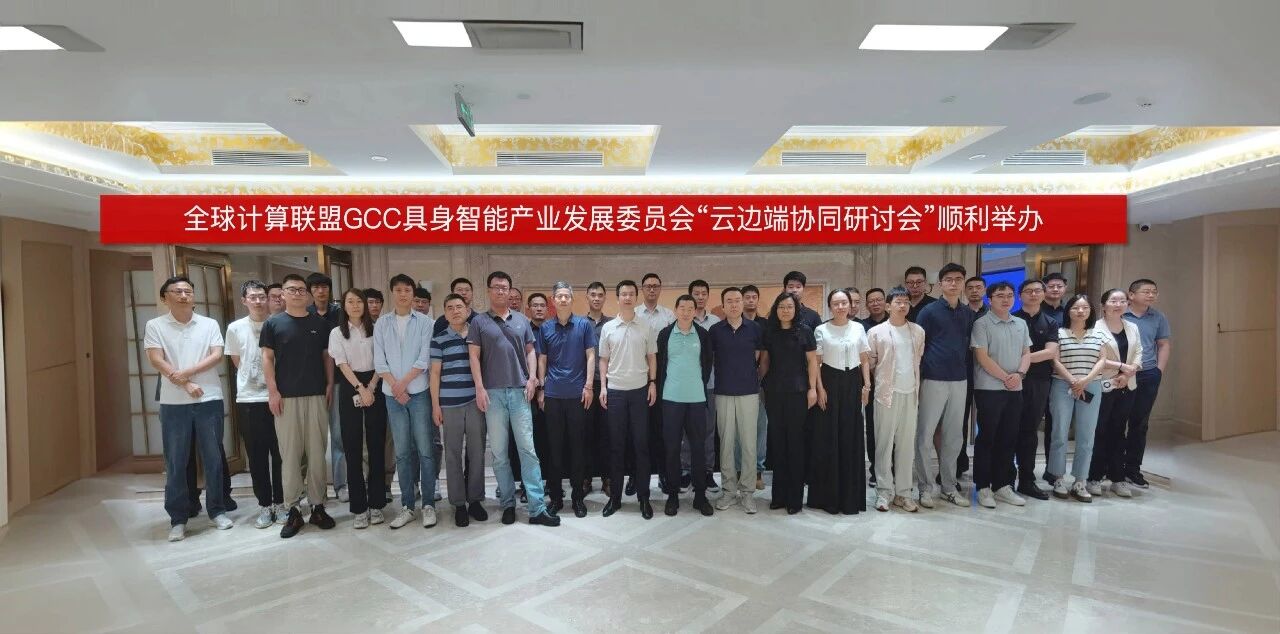
As a core arena in the current AI and robotics industry, embodied intelligence is accelerating its transition from technological R&D to large‑scale commercial deployment. Cloud‑edge‑end collaboration serves as a critical enabler for addressing challenges such as compute scheduling, model deployment, data flow, and scenario adaptation in embodied intelligence. At present, the industry still faces numerous unresolved issues regarding collaborative architectures and industrial interconnections. The GCC Embodied Intelligence Industry Development Committee took the lead in organizing this symposium to identify core problems, build industry consensus, promote the maturation of cloud‑edge‑end collaboration technologies for embodied intelligence, and facilitate the improvement of the industrial ecosystem.
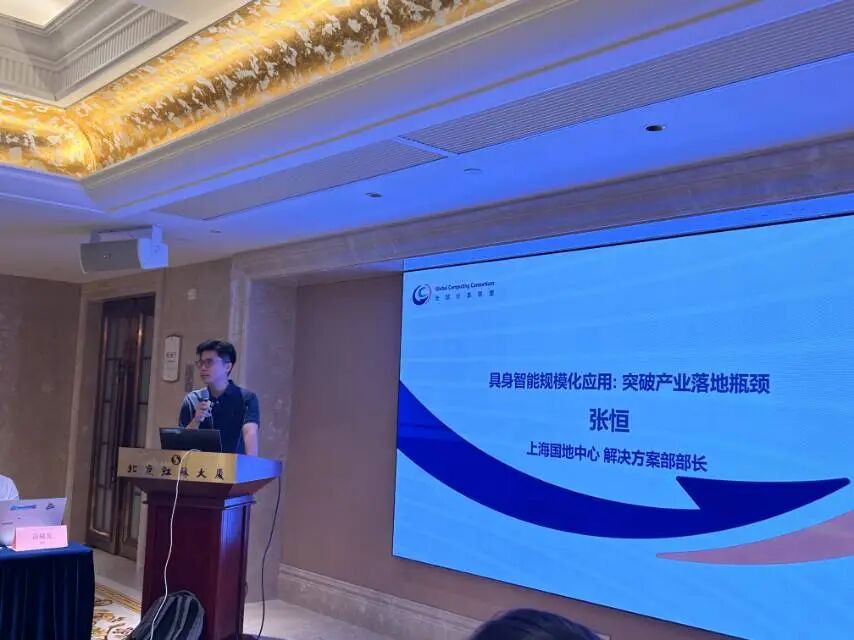
During the dedicated presentation session, experts from leading enterprises and tech startups took the stage to share cutting‑edge insights and practical experiences. Mr. Zhang Heng, Director of the Solution Department at the Shanghai National and Local Joint Engineering Center, opened with a presentation titled "Large‑Scale Application of Embodied Intelligence: Breaking Through Industrial Deployment Bottlenecks," focusing on practical obstacles and exploring pathways for scalable development of embodied intelligence. Mr. Mao Jiming, Co‑founder and Vice President of Beijing Jijia Vision Technology Co., Ltd., shared "World Models: Ushering in the Era of Physical AGI,"systematically outlining the embodied intelligence model framework using the two pyramids of models and data. Mr. Yu Qing, Co‑founder and CTO of Chenhunxian Technology (Beijing) Co., Ltd., elaborated on system‑level exploration and implementation practices ranging from spatial simulation to target causality, centered on embodied world models.
On the solution side, multiple experts from globally leading computing and networking companies provided comprehensive analyses of deployment models, technical solutions, and industry practice cases for cloud‑edge‑end collaboration in embodied intelligence, covering the entire industrial chain including communications, computing power, terminals, and architectures. Mr. Duan Peng, Technical Director of Tianyi IoT, shared insights on industry policies, deployment challenges, cloud‑network‑edge‑end integrated architectures, platform product capabilities, industry applications, and ecosystem co‑construction strategies for embodied intelligence cloud‑edge‑end collaboration. A network and edge computing architect from a leading global computing chip company presented an edge brain solution for embodied intelligence, addressing pain points such as robotic compute power, power consumption, and coordinated synchronization through compute offloading to the upper layers, TSN deterministic networking, and a software‑hardware integrated platform, with deployments in industrial, retail, and other real‑world scenarios. Mr. Liu Jian, Vice President of the AI Product Line at TD Tech, shared research and implementation practices for end‑edge‑cloud collaboration in embodied intelligence, introducing three deployment architectures, software‑hardware platforms, and communication capabilities, showcasing use cases in public safety, emergency response, transportation, and other industries, while also advancing relevant standards and white papers to help robots evolve from single units to collective intelligence. Ms. Zhang Xiaoyan, Senior Product Management Expert for Physical Intelligence at Huawei, addressed the pain points of physical intelligence development, presenting an overall cloud‑edge‑end collaboration solution covering both development and runtime phases, offering technical architectures from the three dimensions of models, computing power, and networks, and sharing factory deployment cases to facilitate large‑scale commercial adoption of embodied intelligence.
In the business discussion session, participating experts engaged in thorough exchanges on the core topics of the symposium, drawing on their respective companies' business scenarios, products, technologies, and industry observations. The discussion focused on the necessity of deploying cloud‑edge‑end collaborative architectures for embodied intelligence, clarifying the applicable scope and specific deployment scenarios for such architectures, and analyzing the key considerations for adopting them. The participants also conducted an in‑depth analysis of the various critical challenges facing large‑scale deployment of cloud‑edge‑end architectures, and separately outlined the specific requirements for the three fundamental resources—compute, network, and storage. The attendees brainstormed technical implementation approaches, collaboration methods, and future industry directions, fostering a lively discussion atmosphere that provided highly valuable input for subsequent work. Finally, the moderator introduced the follow‑up work plan: the GCC Embodied Intelligence Industry Development Committee will initiate the compilation of a special research report on cloud‑edge‑end collaboration for embodied intelligence, and welcomed active participation from all interested parties.

This symposium accurately mapped the industry's technological landscape and current development status, laying a robust foundation for the report compilation. The GCC Embodied Intelligence Industry Development Committee looks forward to active participation and cooperation from enterprises, research institutions, and practitioners across the industry. Upholding the principle of joint contribution and shared benefits, the Committee aims to consolidate industrial synergy, continuously deepen innovation and scenario deployment in cloud‑edge‑end collaboration technologies, and collectively drive the high‑quality development of the embodied intelligence industry.
About the Embodied Intelligence Industry Development Committee:
As a specialized body under the Global Computing Consortium dedicated to building the embodied intelligence industrial ecosystem, the Committee is committed to fostering a robust and prosperous embodied intelligence ecosystem. Its initiatives include leading standards development, promoting open source, conducting technology verification, facilitating industry matchmaking, organizing forums and exchanges, and showcasing achievements. By connecting upstream and downstream resources across the industrial chain, the Committee addresses critical common challenges, accelerates rapid iteration of embodied intelligence technologies, drives continuous cost reduction, and scales up deployment, thereby supporting the sustainable development of a digital and intelligent society.
For inquiries or participation in the Embodied Intelligence Industry Development Committee, please contact:
Ms. Zhao: zhaoyanchao@gccorg.com

 High Performance Computing Development Group(HPC DG)