Six Technical Specifications: AI Infra Systematic Collaboration
Centering around the pragmatic goal of "having standards, having certifications, and being implementable," the OAII Community has released six core specifications, focusing on the standardization of liquid-cooled full rack system architecture and interfaces, providing a unified design basis and implementation guarantee for high-density intelligent computing deployment.
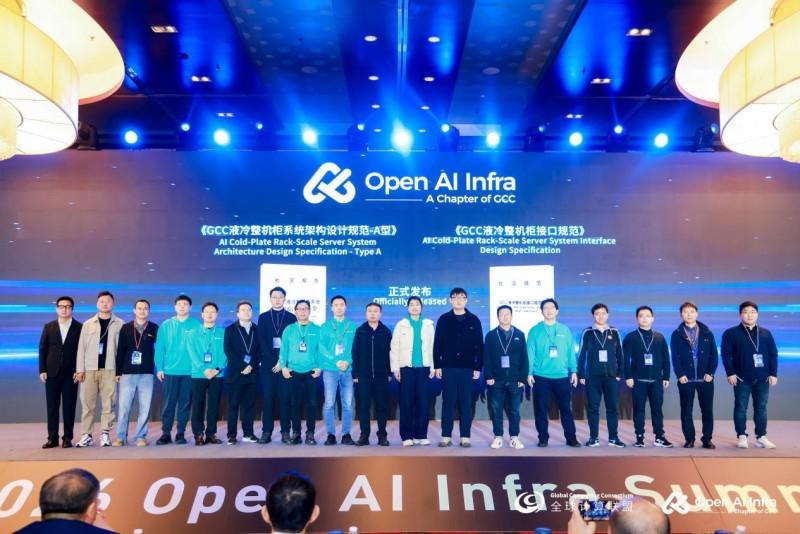
"GCC Liquid-Cooled Rack System Architecture Design Specification - Type A" and "GCC Liquid-Cooled Rack Interface Specification" focus on the standardization of the architecture and interfaces of liquid-cooled rack systems. The former is designed for super-node application scenarios, defining the overall topology, node layout, power supply, and cooling architecture of a 44U rack, adopting blind-mate design for electrical, liquid, and network buses, supporting power evolution from 120kW to 240kW, and covering node forms such as XPU Tray, CPU Tray, and Switch Tray. The latter specifies the interface requirements for AI liquid-cooled full racks and AIDC data centers in terms of mechanical installation, power supply (IEC 60309-2 63A industrial connectors), liquid cooling (DN50 chuck interface), grounding, and drainage, etc., enabling decoupling between the data center and racks and being compatible with multi-vendor full rack deployment.
At the meeting, the <AIDC Infrastructure Specification> was simultaneously released. This specification aims to meet the single cabinet power requirements for the next three to five years
With a 300 kW demand, compatible with the evolution of 2nd to 3rd generation full racks, aiming to achieve decoupled design of the data center and racks, systematic requirements are proposed from building structure (net height ≥ 6m, load ≥ 20 kN/㎡), power supply and distribution (2N architecture, end bus/column head cabinet), cooling (air-liquid flexibility, ring network design) to delivery, operation, and maintenance.
Three series of technical specifications focusing on the safe, reliable, and efficient operation and maintenance of liquid cooling systems were simultaneously released, including the "Technical Specification for Intelligent Operation and Maintenance of Cold Plate Liquid Cooling Systems", the "Key Specifications and Evolution Roadmap of CDU", and the "Technical Specification for Secondary Side Pipeline Process". The "Technical Specification for Intelligent Operation and Maintenance of Cold Plate Liquid Cooling Systems" has established a full lifecycle operation and maintenance system covering online monitoring (temperature, pressure, conductivity, pH, turbidity, etc.), automatic control, liquid leakage protection, daily maintenance, medium detection, and waste liquid disposal. "CDU Key Specifications and Evolution Roadmap" defines key performance parameters of the Cooling Distribution Unit (CDU), such as heat transfer approach (≤3°C), available head (≥25m), and filtration accuracy (≤50μm), and outlines evolution paths including power ratings from 425kW to 2500kW and dual power module redundancy. "Secondary Side Pipeline Process Specification" makes strict provisions for incoming inspection, stainless steel processing (welding, pickling and passivation), assembly, airtightness testing, and packaging and transportation of liquid-cooled secondary side pipelines, ensuring the quality controllability of prefabricated pipeline production.
Two major benchmark tools: Traction calculation performance evaluation system
Currently, the computing power of single machines is gradually reaching its bottleneck, making the system-level evolution of supernodes an inevitable path. At the meeting, the OAII community released two core tool achievements targeting the supernode performance benchmark Benchmark: the intelligent computing supernode AISBench V3.0 and the general computing supernode ClusterBench V1.0.
ClusterBench V1.0 is the first Benchmark tool in the industry specifically designed for performance evaluation of general computing supernodes, and is compatible with interconnection protocols such as UB and CXL.Currently, a total of 8 types of mainstream business load scenarios have been provided, including e-commerce web applications, hotel reservation microservice applications, Redis, PostgreSQL, Spark, Flink, PolarDB, and MySQL. It has the ability to perform peak and trough stress testing that simulates the tidal characteristics of business, supports 3 types of business deployment methods including replicas, expansion, and hybrid deployment, and supports virtual machine and container installation environments.
AISBench V3.0 is a national-level artificial intelligence performance evaluation benchmark targeting the intelligent computing field, relying on the IEEE 2937-2022 international standard and the GB/T 45087-2024 national standard, covering all forms of hardware products such as AI accelerator cards, AI servers, supernodes, intelligent computing clusters, and artificial intelligence computing centers.The model covers mainstream MOE and MultiModal Machine Learning models such as DeepSeek V3/R1, Qwen 2-audio, Qwen 2.5/3-VL, etc., supports concurrent sending of over 100,000 requests, can truly reflect the full stack comprehensive comparison of AI business implementation effects, hardware-software collaboration capabilities, and effective computing power of super nodes, and provides an authoritative measurement scale for intelligent computing product selection, architecture iteration, and efficiency optimization.
The OAII Community stated that in 2026, the Benchmark Project Group will continue to focus on the computing performance benchmark system, advance the version iterations of CPUBench, AISBench, etc., release evaluation benchmarks such as ClusterBench for supernodes, create a benchmark project for AISbench in national economy and people's livelihood evaluations, and promote the implementation and rooting of the intelligent computing evaluation system in the academic community through cooperation with universities.
Two major projects launched: from standards to models, from megawatt-level breakthroughs to industrial collaboration
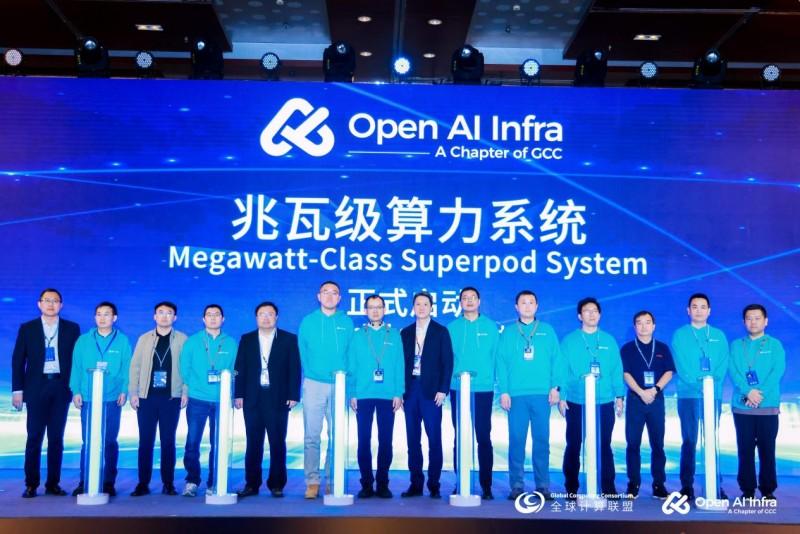
At the meeting, the Open AI Infra Community officially launched the AIDC Model Site Lighting Plan and the AIDC Model Site Certification Project. The creation and certification of model sites are based on the Community's "AIDC Infrastructure Specification", with the certification scale gradually reaching 2GW from 2026 to 2027, demonstrating the benchmark leadership and standard certification of the large-scale implementation of AI infrastructure. Meanwhile, the community officially launched the "Megawatt-level Computing Power System" project. This project was jointly initiated by users such as China Mobile, ByteDance, Baidu, JD.com, and Kuaishou, computing power system partners such as Huawei, H3C, Inspur Hyper, and Ruijie, as well as community industry partners in areas such as liquid cooling, power supply, and interconnection. The megawatt-level computing power system focuses on 4 subsystems for research and standard development: cabinet/node/XPU module, NPO architecture optical interconnection, DC800V native system, and closed-loop liquid cooling system. Guided by real customer needs, we will collaborate with end-users such as leading cloud service providers and intelligent computing center constructors, drive upstream manufacturers of chips, power supplies, optical modules, liquid cooling equipment, etc. to engage in collaborative innovation, jointly develop cross-vendor compatible technical standards and interface protocols, break down ecosystem barriers, and accelerate the maturity and implementation of megawatt-level computing power systems.
The achievements announced at this Open AI Infra Summit reflect the practical philosophy of the OAII community, which emphasizes "having standards, having certifications, and being implementable". From the standardization of the architecture and interfaces of liquid-cooled full racks, to intelligent operation and maintenance and roadmaps for key components, and then to performance benchmarking tools and megawatt-level research projects, a complete AI infrastructure technology ecosystem is taking shape. The details of the relevant specifications are already available for download on the official website of the OAII community. In the future, the OAII community will continue to promote open collaboration and accelerate the two-way cycle of technological innovation and industrial application.

 High Performance Computing Development Group(HPC DG)