On December 25, 2025, the MindSpore AI Framework Summit, jointly hosted by the MindSpore open-source community and the Global Computing Consortium (GCC), was held in Hangzhou. At the summit, MindSpore focused on supernode technology innovation and introduced the MindSpore HyperParallel architecture, accelerating innovation in new model structures and new training and inference paradigms, and leading AI frameworks into the “supernode era.” As one of the organizers of the summit, the Global Computing Consortium (GCC) will continue to work with MindSpore and other industry partners to build an open and prosperous open-source ecosystem.
[Hangzhou, China, December 25, 2025] Today, the MindSpore AI Framework Summit was held at the Hangzhou International Expo Center. With the theme “MindSpore: An AI Framework Born for Supernodes,” the summit was hosted by the MindSpore open-source community and the Global Computing Consortium (GCC), and jointly organized by Huawei Technologies Co., Ltd., OSCHINA, AtomGit, Gitee, AITISA New Generation Artificial Intelligence Industry Technology Innovation Strategic Alliance, OpenI Community, Modelers Community, OpenHarmony Renewal Community, InternLM Community, and MindSpore Community. At the summit, MindSpore focused on supernode technology innovation and introduced the MindSpore HyperParallel architecture, accelerating innovation in new model structures and new training and inference paradigms, and leading AI frameworks into the “supernode era.”
Xie Guilei, President of Huawei Central Software Institute, said in his remarks that the wave of artificial intelligence development is surging forward. MindSpore is moving forward together with the industry and is committed to building an AI framework that is supernode-friendly, integrated across all scenarios, open in architecture, and agile in enablement. With more advanced technologies, a more user-friendly experience, and a more open community, MindSpore will support the intelligent transformation of all industries.
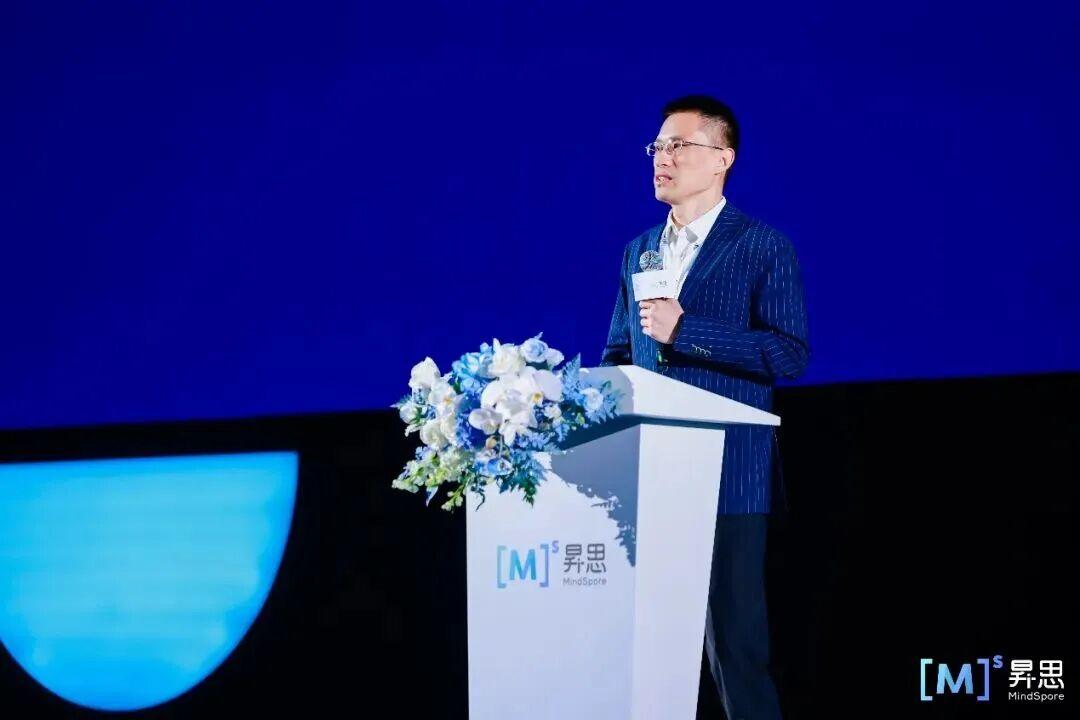
At the summit, Wu Guanghui, Academician of the Chinese Academy of Engineering and Chief Scientist of COMAC, said that large aircraft, known as the “crown jewel of industry,” represent a concentrated embodiment of a nation’s scientific and technological capabilities, industrial strength, and comprehensive power. Aircraft aerodynamic design directly determines the four key characteristics of civil aircraft. Based on continuous innovation using the MindSpore framework, the Shanghai Aircraft Design and Research Institute of COMAC launched “Yufeng Zhiyi,” the industry’s first intelligent agent for aerodynamic design of civil aircraft supercritical airfoils, building a one-stop intelligent solution for supercritical airfoils based on engineering experience.

Five Years of MindSpore Open Source: Growing with Developers and Building a Prosperous Open-Source Ecosystem
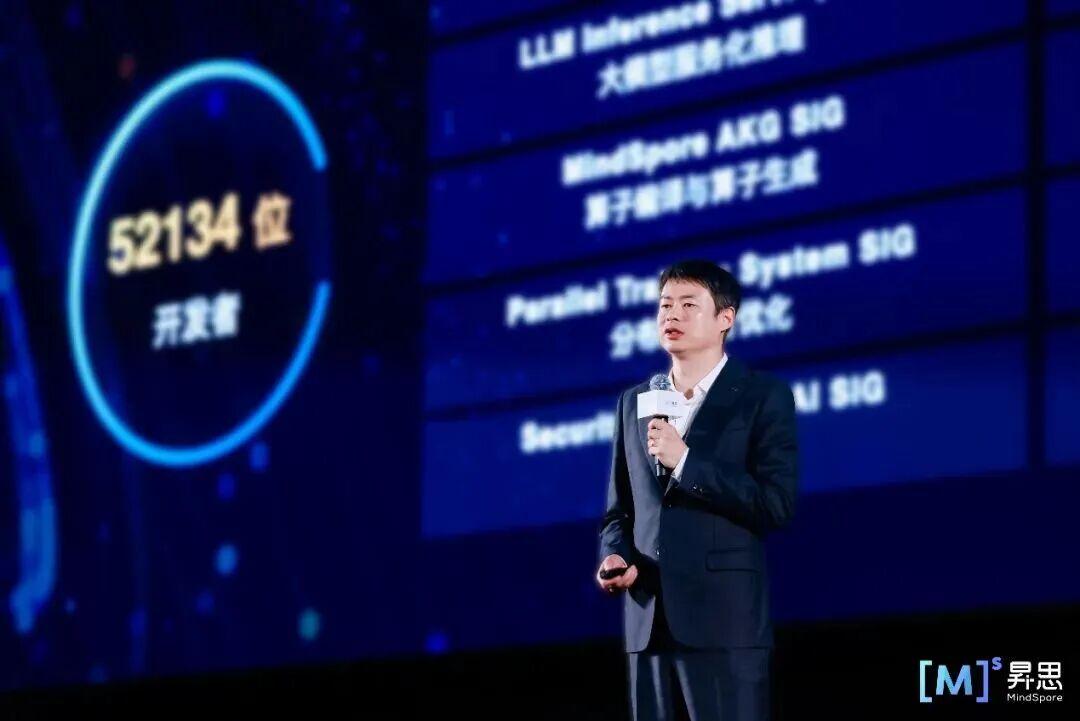
Huawei open-sourced the MindSpore AI framework on March 28, 2020. Since becoming open source, MindSpore has received active support from developers in China and abroad. It has been downloaded more than 13 million times, covering 156 countries and regions worldwide, with over 120,000 merged requests and more than 52,000 community contributors. It supports more than 25 series of large models, works with over 2,000 community partners, has enabled more than 3,100 industry application practices, and has supported innovation in nearly 2,500 academic papers. MindSpore has also become one of the most innovative and dynamic AI framework open-source communities in China.
Ding Cheng, Chair of the MindSpore open-source community, said that the MindSpore community follows open governance and practices the principles of co-building, co-governance, and sharing. At the same time, it actively integrates into the broader industry ecosystem to bring developers a better experience. MindSpore provides full-chain support for AI talent cultivation and helps every developer become a backbone force in the development of the AI industry.
Technological Leap: AI Frameworks Officially Enter the “Supernode” Era
Large model technologies in artificial intelligence are developing rapidly. Model scale is moving toward long-sequence and sparse ten-trillion-level models, model structures are becoming irregular, and training and inference paradigms are becoming heterogeneous. Model development is driving AI infrastructure from the “server cluster era” into the “supernode era,” bringing new challenges and opportunities to AI frameworks as the core foundation of industrial intelligence.
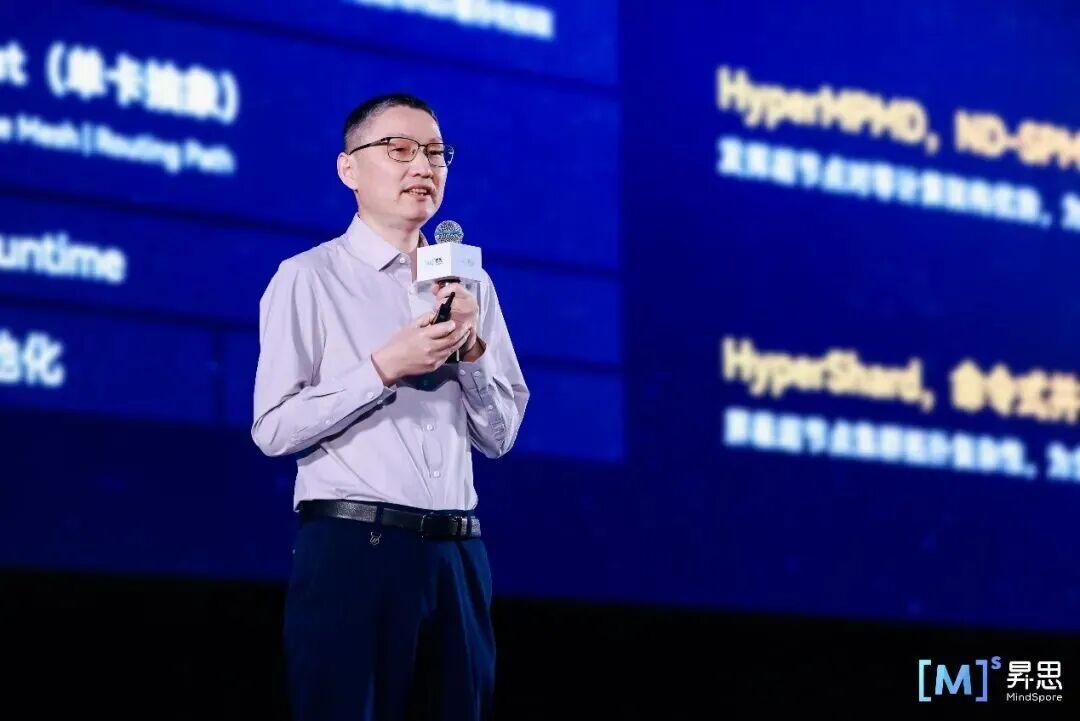
Jin Xuefeng, Chair of the Technical Committee of the MindSpore open-source community, pointed out in his speech that the MindSpore HyperParallel architecture treats the supernode as a “supercomputer” for programming and scheduling. It fully leverages the advantages of the supernode architecture and enables features such as HyperShard declarative parallel programming, HyperMPMD heterogeneous irregular parallelism, and HyperOffload multi-level intelligent offloading, accelerating innovation in new model structures and training and inference paradigms such as Agentic AI and omni-modal models.
HyperOffload enables the separation of computing and state coupling. By using the pooled storage capability of supernodes, it solves the on-chip storage capacity bottleneck caused by growing model scale, improving training performance by more than 20% and increasing inference sequence length by more than 70%.
HyperMPMD enables parallelism to move from SPMD to MPMD. By leveraging the peer-to-peer computing architecture advantages of supernodes, it supports fine-grained parallel partitioning and concurrent general-purpose computing, providing flexible parallel capabilities for reinforcement learning and omni-modal models, and improving computing power utilization by more than 15%.
HyperShard enables a shift from imperative parallel programming to declarative parallel programming. It shields users from the complexity of supernode cluster topology and provides an extremely simple combined programming experience for omni-modal and other models. New algorithm parallelization transformation can be completed in less than one day, and parallel strategy tuning is shortened from days to hours.
A series of award ceremonies were also held at the summit. Eight developers and five evangelists were named 2025 Outstanding Developers and Evangelists of the MindSpore open-source community.
The MindSpore Model Development Challenge focused on frontier MoE and multimodal models, testing participating teams’ practical capabilities in model inference optimization. At the summit, the gold and silver award winners of the challenge received their awards.


 High Performance Computing Development Group(HPC DG)